Howard Florey was never more sleazy than in his dealings with Henry Dawson's team, as he desperately fought to restore the family name that his father dis-honored, by trying to remain the sole "hero" of wartime penicillin.
Just try to imagine what an university ethics committee today might say about a professor using his main rival's unpublished paper, sent to him in secret by his close friend (the same government official who censored his rival's paper and forbade its release) to improve his own work that is about to be allowed to be freely published !
That is what full Professor Howard Florey and university vice president and full Professor A N Richards actually did to associate professor chemist Professor Karl Meyer of Dawson's team , in mid 1942.
(As they say, tenure is 'red in tooth and claw'.)
Showing posts with label gladys hobby. Show all posts
Showing posts with label gladys hobby. Show all posts
Wednesday, January 30, 2013

Sunday, January 20, 2013
Henry Dawson "jump-started" The Age of Antibiotics because, almost alone in the medical world, he wasn't obsessed with 'purity' but rather with 'charity'
We have the records of only a few contemporary reactions to Henry Dawson's surprise decision to dramatically kick-start The Age of Antibiotics, 12 years after it should have begun but three months before it was scheduled to begin , but they are suggestive.
Saturday, January 12, 2013
For female pioneers of wartime penicillin, 1910 was a very good year ...
Dorothy Crowfoot , Gladys Hobby and Nancy Atkinson were about the only women who played an independent role in the development of wartime penicillin.
Thursday, November 29, 2012
Dawson long been obsessed with SBE ? Show me ! 'Cause I'm from Missouri ...
 |
| Dawson & SBE ?! well I'm from MISSOURI |
And God Knows, she should know almost better than anyone but Dawson himself.
Sunday, October 31, 2010
Penicillin, from EROS to AGAPE : synthetic crystals to the natural mold
Anders Nygren,1890-1978, Swedish theologian and pharmacologist ?!
Why not ?
His seminal text of 1932, "Eros and Agape", does offer an unique way to compress the long wartime penicillin saga into something vividly digestible.
On one side, we have Professor Florey.
He basically ignores that:
(a) there is a war on and people are dying daily from infected wounds from the Blitz
(b) that natural impure penicillin had no toxic effects from its impurities and is available - now - to help those Blitz victims.
Despite this,Florey and his wartime coterie of Platonists and New Alchemists wasted their time and ours seeking after the chimera of a 100% pure --- all white---- crystalline penicillin for their Scientific monstrance, to hold aloft before the adoring Faithful.
Its just the sort of New Age nonsense we've come to expect from the hardheaded science departments of Oxford University.
And I really do think that its a 'guy thing' ,this growing of crystals.
Women prefer to grow living things: plants, pets and above all their own children.
But crystals are about the only non-living object that grows before your very eyes.
They don't lay you up for nine or more months,change your shape, never wake you at night, never have to have their diapers changed.
What is there not for men to like ?
And if your vision of BEAUTY sees it as a pure, austere, hard-edged sort of mechanical regularity, you will find it best displayed in crystals.
In Nygren's definition of human EROS love, EROS is found whenever humans seek to ascend to a 'god-like' status , by demonstrating their love for (and ability to grow) beautiful (literally beauty-filled) objects - in this case crystals.
They take in/ draw down some of that beauty
and by loving beauty,add some of its value to their own worthfulness.
But Nygren contrasts this to AGAPE love - a spontaneous, undignified, excessively operatic, self-denying,heart-on-our-sleeve love of the unloveable - with our enemies being the best possible objects of our agape out-flowing.
We don't draw down some of BEAUTY's perfection and purity to give us additional value and to help us ascend upwards.
Instead we give away love -and our life if necessary - down to the 'ugly' and the evil and they gain BEAUTY by our doing so.
We become "like God" by descending to the level of the ugly, flawed and evil and giving them all our love nevertheless -- just as Jesus did.
In 1940 ( as it is in 2010) people tended to see that gooey smelly mold ruining their basement walls and fixtures as something almost evil and definitely ugly and unloveable.
It took a special sort of person to see the worthfulness of the penicillium mold - that person being Doctor Dawson.
His co-worker Gladys Hobby writes of his tiny band of followers creating their own Monstrance of the furry, blue-green, smelly, mold with its clear urine-like drops of yellow penicillin, holding it aloft daily before the unlovable SBE patients, to give them courage and comfort in this world - and in the Next.
And because of Dawson's AGAPE love of this humble mold, millions of other beings - human beings - had their chance to live out their three score and ten.....
Why not ?
His seminal text of 1932, "Eros and Agape", does offer an unique way to compress the long wartime penicillin saga into something vividly digestible.
On one side, we have Professor Florey.
He basically ignores that:
(a) there is a war on and people are dying daily from infected wounds from the Blitz
(b) that natural impure penicillin had no toxic effects from its impurities and is available - now - to help those Blitz victims.
Despite this,Florey and his wartime coterie of Platonists and New Alchemists wasted their time and ours seeking after the chimera of a 100% pure --- all white---- crystalline penicillin for their Scientific monstrance, to hold aloft before the adoring Faithful.
Its just the sort of New Age nonsense we've come to expect from the hardheaded science departments of Oxford University.
And I really do think that its a 'guy thing' ,this growing of crystals.
Women prefer to grow living things: plants, pets and above all their own children.
But crystals are about the only non-living object that grows before your very eyes.
They don't lay you up for nine or more months,change your shape, never wake you at night, never have to have their diapers changed.
What is there not for men to like ?
And if your vision of BEAUTY sees it as a pure, austere, hard-edged sort of mechanical regularity, you will find it best displayed in crystals.
In Nygren's definition of human EROS love, EROS is found whenever humans seek to ascend to a 'god-like' status , by demonstrating their love for (and ability to grow) beautiful (literally beauty-filled) objects - in this case crystals.
They take in/ draw down some of that beauty
and by loving beauty,add some of its value to their own worthfulness.
But Nygren contrasts this to AGAPE love - a spontaneous, undignified, excessively operatic, self-denying,heart-on-our-sleeve love of the unloveable - with our enemies being the best possible objects of our agape out-flowing.
We don't draw down some of BEAUTY's perfection and purity to give us additional value and to help us ascend upwards.
Instead we give away love -and our life if necessary - down to the 'ugly' and the evil and they gain BEAUTY by our doing so.
We become "like God" by descending to the level of the ugly, flawed and evil and giving them all our love nevertheless -- just as Jesus did.
In 1940 ( as it is in 2010) people tended to see that gooey smelly mold ruining their basement walls and fixtures as something almost evil and definitely ugly and unloveable.
It took a special sort of person to see the worthfulness of the penicillium mold - that person being Doctor Dawson.
His co-worker Gladys Hobby writes of his tiny band of followers creating their own Monstrance of the furry, blue-green, smelly, mold with its clear urine-like drops of yellow penicillin, holding it aloft daily before the unlovable SBE patients, to give them courage and comfort in this world - and in the Next.
And because of Dawson's AGAPE love of this humble mold, millions of other beings - human beings - had their chance to live out their three score and ten.....
Monday, August 23, 2010
Yet more SMART women scientists in pearls -Agnes Warbasse II
Thanks to Mo goes Po devotees, I am offering up more photos of SMART women scientists in pearls.
I have to dash off to work to fill in for a sick employee ,( remember what I said about not forgetting the impact of ordinary 'day job' demands on all the wartime penicillin participants?), so this will be very brief and I will expand it in a later blog.
Agnes Warbasse ,(Junior? or Second,/II ?- we seem to have no convention for mothers and daughters who share the same first name and who both become prominent), was the co-author on what I claim was Martin Henry Dawson's most important paper.
That it is among his least known and least cited doesn't change my argument - in fact I claim it was and isn't cited because of its revolutionary nature.
Agnes Warbasse married in the early 1930s ------and as most married women did then and frequently do today, changed her job to suit her husband's career path - so she left Dawson's lab.
But for two years, between late 1929 and mid 1931, she was Dawson's first research assistant.
Here is a photo of her from around that time period:
I have to dash off to work to fill in for a sick employee ,( remember what I said about not forgetting the impact of ordinary 'day job' demands on all the wartime penicillin participants?), so this will be very brief and I will expand it in a later blog.
Agnes Warbasse ,(Junior? or Second,/II ?- we seem to have no convention for mothers and daughters who share the same first name and who both become prominent), was the co-author on what I claim was Martin Henry Dawson's most important paper.
That it is among his least known and least cited doesn't change my argument - in fact I claim it was and isn't cited because of its revolutionary nature.
Agnes Warbasse married in the early 1930s ------and as most married women did then and frequently do today, changed her job to suit her husband's career path - so she left Dawson's lab.
But for two years, between late 1929 and mid 1931, she was Dawson's first research assistant.
Here is a photo of her from around that time period:
 |
| AGNES WARBASSE II |
Here is a photo of Dawson's last female research associate, Gladys Hobby :
 |
| Gladys Hobby I think it is the eyes that grab you in both shots - the two women seem to be to be intelligent and yet guarded or self-contained. Quietly self confident. Now I must be off to work ... |
Friday, August 20, 2010
more HOBBY more PEARLS
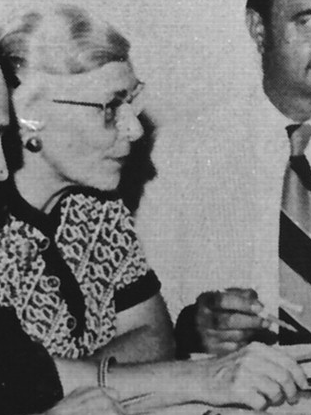
GLADYS HOBBY in 1971, chairing the editorial board of the scientific journal she founded
Of course, people wanted more pictures of Gladys Hobby.
Well there is one color one, Hobby with Fleming, but it is all too common on the web already for me to add another copy.
But here are a few more, with pearls, natch.
I haven't put out any photos of Meyer or Hunter or Odlum as they are well represented on the web.
But women always get short shrift, in photographs as well as in life in general.
I would really like to see a photograph of Eleanor Hahnel (of GAF industries in the 1960s) aka Eleanor Chaffee, (grad of the University of Connecticut 1937).
Or a photo of Miriam Olmstead (girlfriend of Robert Goddard of rocket fame), aka Miriam Lipman, spouse of artist Michael Lipman, aka a woman who did much to make Rheumatoid Arthritis and all auto immune diseases more understandable, if not yet much more treatable.
If you can help, leave me a comment below.
Until then, enjoy a few more pictures of Gladys Hobby:
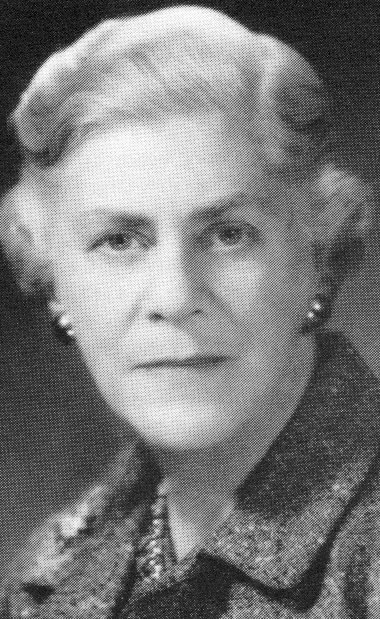
Hobby in a formal pose , age about 75
 |
| From a picture taken of Hobby with Dr Ethel Florey, the clinician-wife who rode around on her bike in the rain collecting penicillin from patients' urine while her husband ,Howard Florey, played 'find the salami' with his mistress back in his apartment-like office at the DUNN ---- and then got most of the credit for Ethel's clinical penicillin work...ain't it always the way ? |
Hobby finally gets her due
Today the best known member, at least among the general public, of the tiny Columbia University team that did the most to bring penicillin to the public as soon as possible (and did so over Columbia's dead body) is Gladys Hobby.
It is a fame she never enjoyed while still active in antibiotics.
The terminally ill Henry Dawson gets most of the credit for providing the moral energy and drive to the Columbia penicillin effort - something that Hobby and Meyer were always forthright in reminding people.
Karl Meyer lived the longest of the main foursome and lived long enough to see his lifelong scientific interest, hyaluronic acid, become a virtual growth industry.
The fourth member ,Eleanor Evelyn Chaffee (aka Mrs Eleanor Hahnel?), will emerge from the shadows, if it is the very last thing I do.
Thomas Hunter first saw fame for finishing Dawson's proof that penicillin could cure the incurable - SBE. Then he became a medical school dean best known for promoting medical education in the third world.
The fairy godfather of the team, Floyd Odlum, is probably best known today for displacing Howard Hughes at RKO.
Miriam Olmstead is today best known as a former girlfriend of the Rocket man, not Elton John, but rather Robert Goddard.
There were a few others, not as invisible as Chaffee ,but rarely connected today to this pioneering penicillin effort.
Hobby after penicillin went on to discover and prove up other big antibiotics and then take leadership roles in science organizations when few women were permitted to do so.
As a result we get many bare bones bios of her - celebrating what she did but not why.
The best - by far - of these is Elizabeth Moot O'Hern's "WOMEN SCIENTISTS" .
It is based on a 1977 interview with Hobby and includes some rare photos of Hobby - most other accounts re-cycle the photograph of Hobby shepherding Fleming about on his tour of South America.
{{What I really want is a photo of Hobby without her pearls - she always wore them - particularly at work in the lab - she was someone that people of my mother's generation would call a 'looker' because of her sharp dress and make-up.
Perhaps this was a survival technique for daring to work above her station in a very male-dominated world.
But those pearls ----I bet the woman wore them in the bath and to bed !
Perhaps not to church though - a true 'old skool' Presbyterian...}}
But O'Hern's admirable account fails to explain the 'why' in Hobby's four year struggle to bring penicillin to the public, over the opposition of many powerful forces.
I think Professor Jeremy Greene, from Harvard's History of Science Department, does a great job with the 'why' in his brief bio of Hobby in "NOTABLE AMERICAN WOMEN" edited by Susan Ware et al.
He focuses on her very first articles to explain how she came to hold a unique bridge role between the biological and chemical approaches to defeating bacterial infections.
Greene says she defends the validity of studying non-pathogenic bacteria .
(This was a real career-loser between 1870 and 1960 in medical science.)
Dawson's entire career - again opposed to his day job - was also devoted to exploring non- pathogens and pathogens as equally interesting and equally viable ways for commensal bacteria to survive in the human body.
This bonded Hobby to Dawson.

A deep commitment to seeing new research put to work saving lives, even if it hadn't been all explained in scientific terms, was what bonded Meyer to Hobby.
Meyer was the rarest of 1930s biochemists - he was clinically oriented.... aka he was face to face people-oriented.
Dawson's team was very small and not well supported by his university --- but having two such unusual people to work with him (Hobby and Meyer) helped make up for this....
 |
| GLADYS LOUNSBURY HOBBY Nov 19 1910 -July 4 1993 |
It is a fame she never enjoyed while still active in antibiotics.
The terminally ill Henry Dawson gets most of the credit for providing the moral energy and drive to the Columbia penicillin effort - something that Hobby and Meyer were always forthright in reminding people.
Karl Meyer lived the longest of the main foursome and lived long enough to see his lifelong scientific interest, hyaluronic acid, become a virtual growth industry.
The fourth member ,Eleanor Evelyn Chaffee (aka Mrs Eleanor Hahnel?), will emerge from the shadows, if it is the very last thing I do.
Thomas Hunter first saw fame for finishing Dawson's proof that penicillin could cure the incurable - SBE. Then he became a medical school dean best known for promoting medical education in the third world.
The fairy godfather of the team, Floyd Odlum, is probably best known today for displacing Howard Hughes at RKO.
Miriam Olmstead is today best known as a former girlfriend of the Rocket man, not Elton John, but rather Robert Goddard.
There were a few others, not as invisible as Chaffee ,but rarely connected today to this pioneering penicillin effort.
Hobby after penicillin went on to discover and prove up other big antibiotics and then take leadership roles in science organizations when few women were permitted to do so.
As a result we get many bare bones bios of her - celebrating what she did but not why.
The best - by far - of these is Elizabeth Moot O'Hern's "WOMEN SCIENTISTS" .
It is based on a 1977 interview with Hobby and includes some rare photos of Hobby - most other accounts re-cycle the photograph of Hobby shepherding Fleming about on his tour of South America.
{{What I really want is a photo of Hobby without her pearls - she always wore them - particularly at work in the lab - she was someone that people of my mother's generation would call a 'looker' because of her sharp dress and make-up.
 |
| Note the pearls .... |
Perhaps this was a survival technique for daring to work above her station in a very male-dominated world.
But those pearls ----I bet the woman wore them in the bath and to bed !
Perhaps not to church though - a true 'old skool' Presbyterian...}}
But O'Hern's admirable account fails to explain the 'why' in Hobby's four year struggle to bring penicillin to the public, over the opposition of many powerful forces.
I think Professor Jeremy Greene, from Harvard's History of Science Department, does a great job with the 'why' in his brief bio of Hobby in "NOTABLE AMERICAN WOMEN" edited by Susan Ware et al.
He focuses on her very first articles to explain how she came to hold a unique bridge role between the biological and chemical approaches to defeating bacterial infections.
Greene says she defends the validity of studying non-pathogenic bacteria .
(This was a real career-loser between 1870 and 1960 in medical science.)
Dawson's entire career - again opposed to his day job - was also devoted to exploring non- pathogens and pathogens as equally interesting and equally viable ways for commensal bacteria to survive in the human body.
This bonded Hobby to Dawson.

A deep commitment to seeing new research put to work saving lives, even if it hadn't been all explained in scientific terms, was what bonded Meyer to Hobby.
Meyer was the rarest of 1930s biochemists - he was clinically oriented.... aka he was face to face people-oriented.
Dawson's team was very small and not well supported by his university --- but having two such unusual people to work with him (Hobby and Meyer) helped make up for this....
Wednesday, June 30, 2010
Dawson had been set to be the "invisible man", the Charles Fletcher of The Manhattan Pilot
I believe that for two critical weeks at the very beginning of the The Manhattan Project, Martin Henry Dawson was not set to be the team leader/senior investigator - in fact he was not expected to be involved at all.
The team was supposed to be led by the biochemist Karl Meyer, with someone (anyone) acting as the microbiologist to test the 'in vitro' activity of the penicillin produced , again with some doctor (anyone) from Columbia Presbyterian's eye clinic in the clinician's job (the nominal job of Dawson on the final Pilot team) .
The penicillin pilot's aim, at that point, was simply (!) to purify and then synthesize penicillin - most of the small amounts of crude penicillin produced would have to be destroyed in crystallization (purification) experiments.
Only tiny, tiny amounts could be spared to show the resulting penicillin still retained the needed biological activity against bacteria on a glass slide or against bacteria on/in a human.
These were expected to be merely subordinate activities to the main show - "making penicillin".
These were expected to be merely subordinate activities to the main show - "making penicillin".
Now any drug, not just penicillin, needs to be first proven safe for humans when taking internally and be available in huge amounts, before it can be injected into the body as a 'systemic' --- versus simply being dropping a bit of it into the restricted/external area around the eyeball as an 'antiseptic'.
Penicillin, in particular, quickly slips out of the body and so needs even larger amounts than most drugs to work successfully as a systemic.
This is why penicillin's first successes in Britain during the 1930 (but tragically for humanity never published), were in removing deadly bacteria from the area around the eyes.
Meyer ,working in an eye clinic ,knew these truths better than most. In fact, he did involve two doctors from his clinic to use some of his penicillin with their patients but both doctors (Von Sallmann and Thygeson) seemed dubious about its usefulness around and in the eyes (as well they should have been).
The results were not spectacular and were published a few years later.
Eyes were saved in the early 1930s from a lifetime of blindness with treatments of diluted crude penicillin that in total must have consisted of only 1.6 Oxford units of biological activity (that is equal to one millionth of a gram of pure penicillin).


By contrast, Dawson's disease of choice to test penicillin upon, SBE, subacute bacterial endocarditis, may today require 1.6 billion units of penicillin to cure.
That is one kilogram of pure penicillin - one billion times as much penicillin.
It was known in 1940 that SBE would need an extraordinary large amount of whatever drug that could kill the bacteria in its vegetations because of the unique location of the lesions and the poor blood supply of the heart valves they rested upon- that is the problem in fact that still makes SBE the 'gold standard' of intractable infections.
All drugs to date, as of 1940, had to be used in such large amounts to kill the bacteria that they killed the patient first - because even a relatively "non-toxic" drug is deadly if used by the shovelful !
It was Dawson's genius to see that penicillin's strength was not what the popular books on it still proclaim - its ability to kill bacteria - but rather its ability not to kill the patients, even when used in extraordinarily high amounts for months at a time.
And SBE proved to be just the disease to demonstrate that fact....
@MichaelMarshallMogoesPo
Subscribe to:
Posts (Atom)